How battery storage can facilitate heating electrification and commercial fleet charging in a period of heightened grid constraint
A small distribution unit on a 150 kVA connection electrifies its heating and its fleet. Charging the vehicles on a smart overnight schedule still leaves the site above its agreed capacity for 2,868 hours a year. A battery and a modest solar array on the same site entirely remove the need for grid connection enhancement.
Key findings
- Smart charging halves the peak and doubles the breaching hours. Charging fifteen vehicles on arrival takes this site to 445.3 kW and puts it above its maximum import capacity for 1,556 hours a year. Spreading the same energy across the plug-in window brings the peak down to 237.9 kW and takes the breaching hours up to 2,868. A tall, short problem becomes a low, long one, and a site that judges its connection by its peak alone will not see the second one coming.
- How much of the building is heated decides the size of the problem. Heating the whole 15,000 m² floor with a heat pump adds 108.4 kW of peak load. Heating only the 4,500 m² that is occupied adds 36.5 kW. The second is a change this connection absorbs almost entirely and the first is not.
- Storage removes the breach, and solar makes it cheaper. A 2 MWh battery takes the site to zero breaching hours, and so does a 1.2 MWh battery with 150 kWp of rooftop solar behind it, at a rough £506,000 against £621,000. The array earns its place in the three months it generates least, by widening the window in which the battery can refill.
- The value of this battery is not a revenue line. Raising the maximum import capacity from 150 to 238 kVA would cost £1,635 a year, which is trivial. What the storage buys is the ability to proceed while the connection queue runs from 41 GW to 125 GW in seven months, and for an operator serving a European zero-emission zone that is the difference between keeping a contract and losing it.
Every half-hourly metered site in Great Britain holds an agreed capacity with its distribution network operator, usually called the Maximum Import Capacity or the agreed supply capacity. It is a number in kVA, fixed when the connection was made, and it is the ceiling on what the site may draw in any half hour.
The site below is a real half-hourly meter from a 15,000 m² distribution warehouse: 330,947 kWh a year, peaking at 122.3 kW against a 150 kVA agreed capacity.1 It runs a weekday shift from about 06:00 to 15:00 and holds a base load near 18 kW overnight and at weekends.
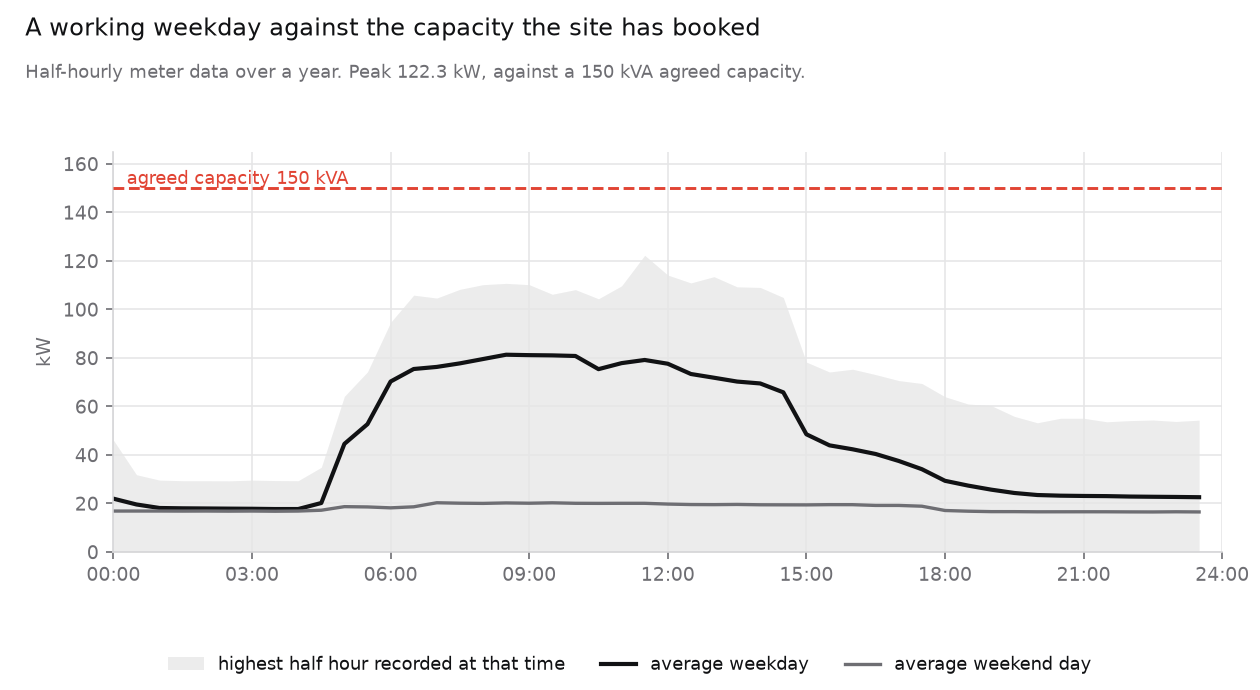
What the capacity costs, and why you cannot simply exceed it
Capacity is billed per kVA per day based on the agreed MIC, irrespective of the actual power drawn. This site's contract prices it at 5.09p/kVA, so 150 kVA costs £2,787 a year. Across the 2025/26 charging statements of Great Britain's fourteen distribution networks the rate runs from 3.36p to 19.33p, so depending on the location, the same capacity is worth £1,840 a year in one region and £10,583 in another.2
A site in persistent breach of its connection agreement can be disconnected. Getting more capacity depends on the queue, which Ofgem reported on 6 November 2025 had gone from 41 GW of contracted demand connections in November 2024 to 125 GW in June 2025.
Electrifying the heating
In this particular case, a 15,000 m² logistics building with a volume of around 180,000 m³, heated to a minimum working temperature of 14 °C would typically be heated by gas radiant tubes which warm the floor, the racking and the people directly without needing to heat the air itself. Electrification is not a like-for-like swap as heat pumps simply cannot generate the same temperatures, and the practical alternative is therefore a heat pump serving warm air units with destratification fans, which requires that the air itself be brought up to temperature.
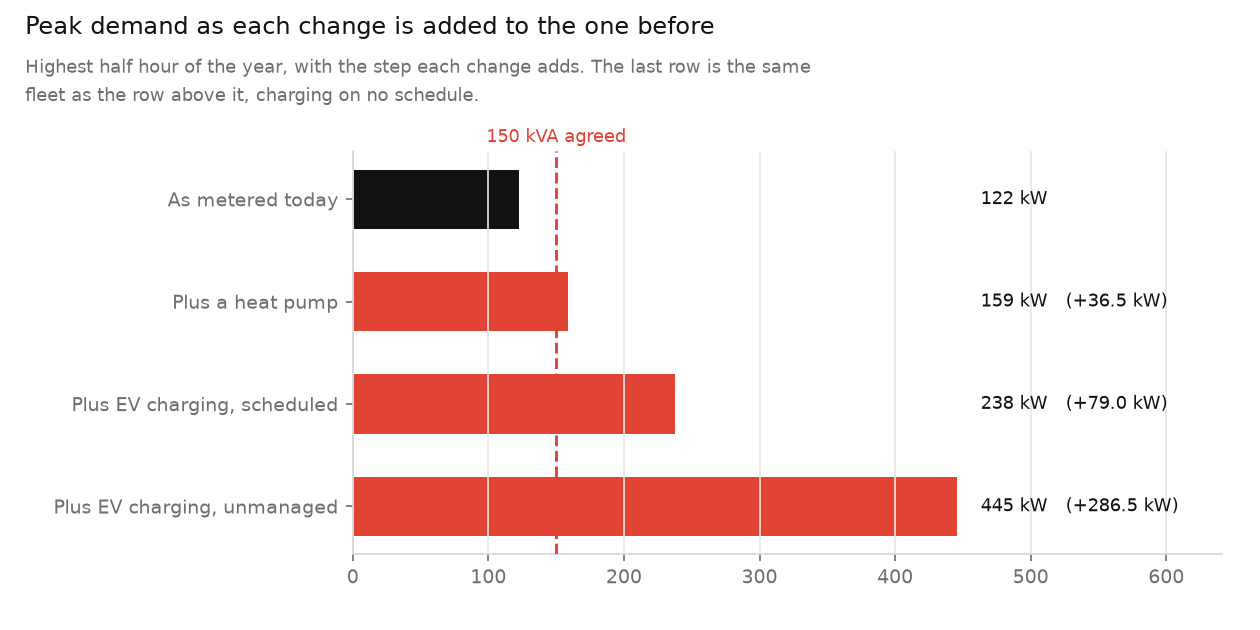
Heated across the entire floor area, that adds around 250 MWh a year of additional consumption annually and 108.4 kW of peak load, taking the site from 122.3 kW to 230.7 kW. Heated only across the occupied zone, 4,500 m² covering the pick face, despatch and offices, it adds around 86 MWh a year and 36.5 kW of peak, taking the site to 158.9 kW. For the purposes of this analysis, we have assumed that we would pursue the latter.
Adding an EV fleet
The electrification of the fleet assumes eight 3.5-tonne vans covering 120 km a day, and seven 18-tonne rigids covering 200 km a day. That is 1,828 kWh a day, or 477 MWh of additional load a year, against a building that currently uses 331 MWh.
| Cumulative | Energy | Peak | Step | Capacity needed | Hours above 150 kVA |
|---|---|---|---|---|---|
| As metered today | 331 MWh | 122.3 kW | 123 kVA | 0 | |
| Plus a heat pump | 416 MWh | 158.9 kW | +36.5 kW | 159 kVA | 2 |
| Plus EV charging, scheduled | 893 MWh | 237.9 kW | +79.0 kW | 238 kVA | 2,868 |
| Plus EV charging, unmanaged | 894 MWh | 445.3 kW | +286.5 kW | 446 kVA | 1,556 |
With vehicles charged on arrival, peak load reaches 445.3 kW, nearly three times the existing connection, with load sitting above 150 kVA for 1,556 hours a year, or 17.8 per cent of all hours.
Instituting smart charging, whereby you spread the same energy evenly across the hours the vehicles are plugged in, brings the peak down by 207 kW, from 445.3 to 237.9. However it is still 87.9 kW above the agreed capacity, and it remains above 150 kVA for 2,868 hours a year, or 32.7 per cent of all hours: more than twice as many hours as the unmanaged case. Smart charging halves the peak and doubles the number of breaching hours, converting a tall, short problem into a low, long one.
Removing the breach with on-site storage and generation
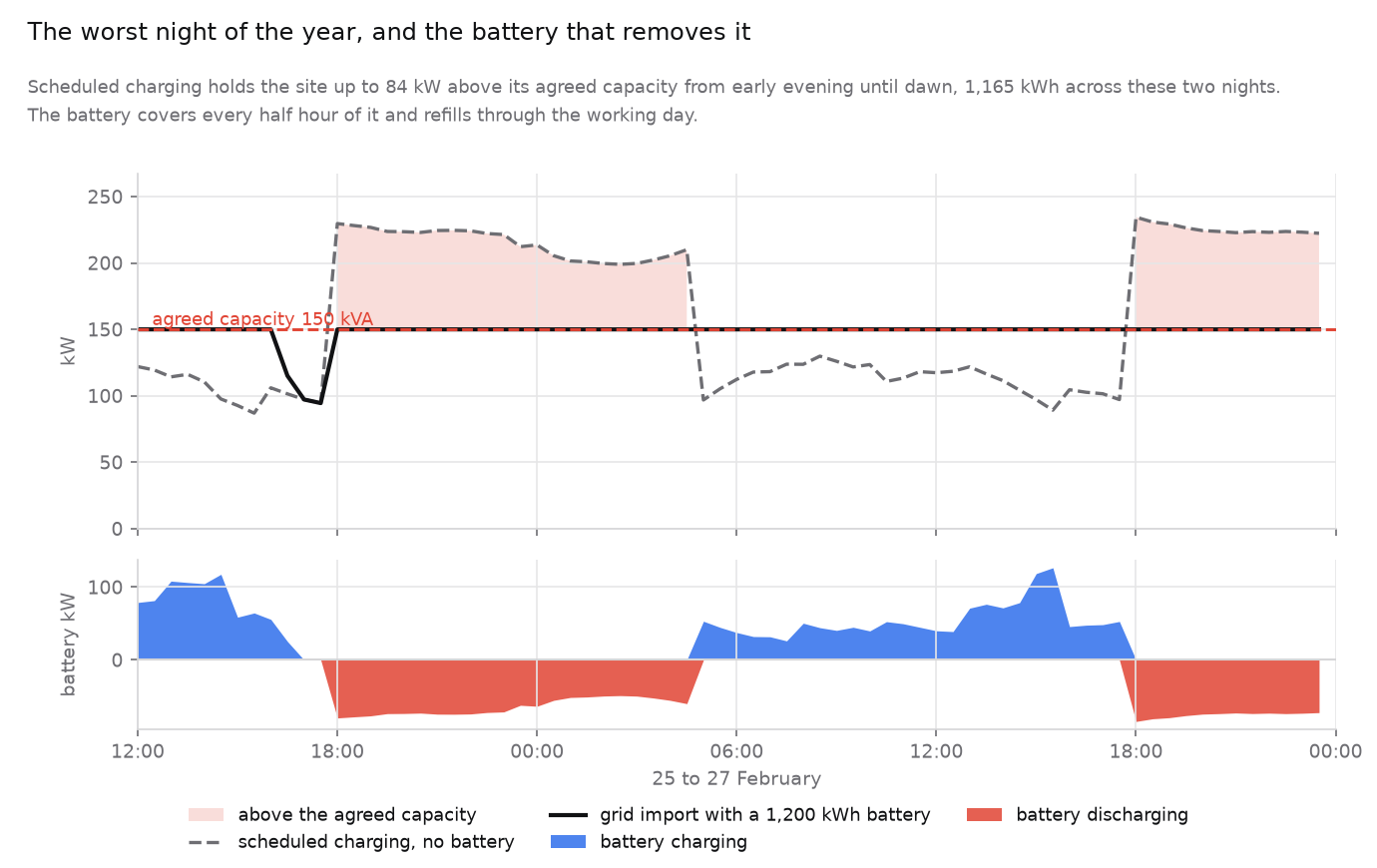
All breaches can be removed with the addition of a 2 MWh battery. However, by adding 150 kWp of roof-mounted solar the same result can be achieved alongside a 1.2 MWh battery, a far cheaper combination with added benefits beyond the grid constraint mitigation.
| On site, with charging already scheduled | Hours above 150 kVA |
|---|---|
| No storage | 2,868 |
| 800 kWh battery | 184 |
| 1,200 kWh battery | 78 |
| 1,600 kWh battery | 12 |
| 2,000 kWh battery | 0 |
| 1,200 kWh battery and 150 kWp solar | 0 |
The chart shows the mechanism across the worst two nights of the year. From about 17:30 the site would climb past 220 kW and stay there until dawn. The battery discharges through the entire period, holding import at the limit of 150 kVA, and then utilising the headroom present during the working day to recharge.
Solar widens that recharge window, and it does so in the months you would least expect. The 78 hours a 1.2 MWh battery cannot cover on its own all fall between November and March, in the small hours, when the battery has been discharging since early evening and reaches its floor before the morning shift begins. Winter days are short and the heating load is at its highest, so the window in which the battery can refill inside the limit is at its narrowest exactly when the nights are longest. Adding 150 kWp lifts the lowest state of charge the battery reaches across the year from its 120 kWh floor to 139.7 kWh, and the last 78 hours disappear.
That is an unusual way to value an array. Only 26 per cent of its output falls in those five months, and the summer generation that would ordinarily justify it is largely surplus here. It is being sized for the months it is needed rather than the season it performs in.
It also cannot be relied on. A dull spell, or snow lying on the roof, returns the site to the battery-only case and its 78 breaching hours. A site that must never exceed its connection therefore needs either the larger battery or standby generation behind the array, and the choice between them is a question about what a breach actually costs.
The rough cost of 2 MWh of storage is £621k, while 1.2 MWh of storage combined with a 150 kWp array would cost around £506k. The array pays for itself twice over in battery it removes, before generating a kilowatt hour of value on the bill. Around 26 per cent of its output, 42,780 kWh of 164,557 kWh, arrives when neither the site nor the battery can absorb it: with an agreed export capacity that goes to the grid, and without one it is curtailed. Either way it is the price of sizing the array for the winter rather than the summer.
What it costs, and what it is worth
Alongside around £506k of upfront capital a combined 1.2 MWh BESS and 150 kWp solar PV system would come with around £7k a year of operating cost.
A battery held in reserve to protect a site's grid connection is not available to do anything else. It cannot simultaneously chase flexibility payments, arbitrage a wholesale spread or run a merchant strategy, because the state of charge it needs at 17:00 every evening is dictated by the fleet rather than by a price signal. Its value does not therefore appear as a revenue line in a cashflow model.
What it buys instead is the ability to proceed. Raising the agreed capacity from 150 to 238 kVA would cost £1,635 a year in capacity charges, which is trivial, but if the connection cannot be enhanced for five years, then for those five years the storage is the difference between electrifying the fleet and not electrifying it. This can have significant commercial implications. In the Netherlands, zero-emission zones for urban freight came into force on 1 January 2025 under the 2019 National Climate Agreement, and are set by individual municipalities. Around 18 cities began that year, among them Amsterdam, Rotterdam, The Hague, Utrecht, Eindhoven, Groningen and Tilburg, with roughly 30 planned by 2030. Older diesel vans and lorries are excluded, subject to transitional dates running to 2027 for Euro 5 vans, 2028 for Euro 6 and 2030 for trucks. Consequently, by the middle of 2025, 78 per cent of new vans and 76 per cent of new medium trucks registered in the Netherlands were battery electric, the highest share in the European Union. For an operator serving those city centres, an electric fleet is no longer simply a decarbonisation project but a condition for retaining its contracts.
Where a battery is not holding a connection open, what it earns depends on the tariff it is dispatched against. Day-ahead price spreads in ten European markets sets out how far prices move within a day in each of them, and half-hourly grid carbon intensity measures what moving that energy does to a site's emissions.
Common questions
What is maximum import capacity?
Maximum import capacity, or MIC, is the capacity a site agrees with its distribution network operator, the DNO, measured in kVA and fixed when the connection is made. It is the ceiling on what the site may draw in any half hour, and it is billed per kVA per day on the number agreed rather than on the power actually drawn. It is also called the agreed supply capacity.
What happens if a site exceeds its maximum import capacity?
The capacity drawn above the agreed figure is charged at the exceeded capacity rate, and a site in persistent breach of its connection agreement can be disconnected by the DNO. Getting more capacity depends on the connection queue, which Ofgem reported had gone from 41 GW of contracted demand connections in November 2024 to 125 GW in June 2025.
How much does import capacity cost a year?
On the site in this article, 5.09p per kVA per day, so 150 kVA costs £2,787 a year. Across the 2025/26 charging statements of Great Britain's fourteen distribution networks the rate runs from 3.36p to 19.33p, so the same 150 kVA is worth £1,840 a year in one region and £10,583 in another.
Will EV charging exceed a site's import capacity?
On the site modelled here it does. Eight 3.5-tonne vans and seven 18-tonne rigids add 477 MWh a year to a building that currently uses 331 MWh. Charged on arrival they take the peak to 445.3 kW against a 150 kVA connection, which is nearly three times the existing capacity.
Does smart charging solve a capacity problem?
It changes its shape rather than removing it. Spreading the same energy evenly across the hours the vehicles are plugged in brings the peak down by 207 kW, from 445.3 to 237.9, but the site then sits above 150 kVA for 2,868 hours a year against 1,556 hours when charging is unmanaged. Smart charging halves the peak and doubles the number of breaching hours.
Can a battery avoid a grid connection upgrade?
On this site it can. A 2 MWh battery removes every breaching half hour, and so does a 1.2 MWh battery paired with 150 kWp of rooftop solar, at a rough capital cost of £506,000 against £621,000. A battery held in reserve to protect a connection is not free to earn elsewhere, so its value is the ability to proceed rather than a revenue line.
Try Lupa free for sixty days and run your own site against its agreed capacity
Notes
- The meter covers September 2023 to September 2024, every reading flagged actual, mapped onto a calendar year by shifting whole weeks so each weekday lands on the same weekday, then scaled to a unit on a 150 kVA supply; only the level is scaled. One day was excluded, because on 9 April 2024 the meter recorded near-zero values paired with inflated ones, which is a meter recording nothing in one half hour and the accumulated energy in the next. The 150 kVA capacity is stated, about 20 per cent above the measured peak. Heat loss is calculated from the building rather than from a floor-area rule, at minus 3 °C with 0.25 air changes an hour, and the heat pump runs at a coefficient of performance of 2.0, the design-point figure rather than the 2.8 it averages across a year. Vehicle distances and intensities follow the Department for Transport's van survey and the Battery Electric Truck Trial. Solar is a PVGIS profile for eastern England at 1,097 kWh per kWp. Unity power factor is assumed, so a site with a poor power factor breaches sooner than these figures show, and battery dispatch is causal rather than optimised with foresight, so it is a lower bound. ↩
- The cheapest is Northern Powergrid's Yorkshire network at high voltage, at 3.36p per kVA per day. The dearest is Scottish and Southern Electricity Networks' North Scotland network, also at high voltage, at 19.33p. Both are 2025/26 published rates. ↩