P415 and its equivalents across Europe
Behind-the-meter (BTM) batteries need access to wholesale electricity pricing to realise their full potential, both in terms of realising the maximum revenue and providing the maximum level of flexibility to the grid. The UK is arguably the leading country in Europe in terms of creating the conditions for this. However, as this article explains, the general level in Europe is low, and the UK's conditions are not without their issues.
Key findings
- A battery can reach wholesale prices in one of two ways: through a supply contract that passes the price through, or by letting an independent aggregator trade it. The second needs a market rule to exist.
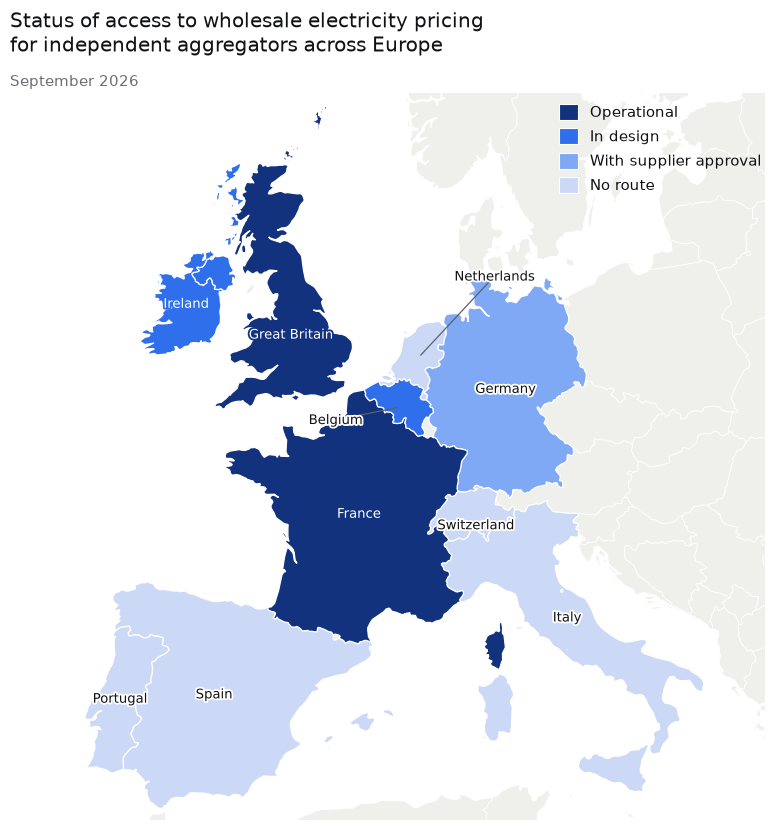
- Of the ten European markets examined here, only Great Britain and France have a route an aggregator can use in practice.
- Belgium has written the rule and recorded no use of it. Ireland has been designing one since 2019. Germany requires the supplier's agreement. The Netherlands, Spain, Portugal, Italy and Switzerland have nothing.
- Great Britain's rule works by spreading the cost of compensating suppliers across everyone's bills. That has proved open to abuse, and from 24 August 2026 generators exporting more than 10 MW have been shut out of it.
- For a commercial or industrial site, the practical route in eight of the ten markets remains the supply contract.
The importance of accessing wholesale electricity pricing
A battery largely earns money by charging when electricity is cheap and discharging when it is expensive. To do that it has to either:
- be used at a building which has a contract that passes the half-hourly market price straight through to the end user, or
- allow a third party to trade the battery on the wholesale market, leaving the supply contract alone. This route requires permission from the market's rules.
While full pass-through tariffs are widely available across Europe, they are rare in practice because of the perceived risk of being entirely at the mercy of the wholesale market. That risk is real: the most expensive half hour of 2025 in Great Britain settled at £1,353 per MWh, roughly seventeen times the year's average of £80.
In this article, we explore the second of these two options, exploring the state of play across ten European markets, and demonstrating that it is only in the UK and France where this second route is widely accessible.
Route one: Great Britain, where everyone shares the bill
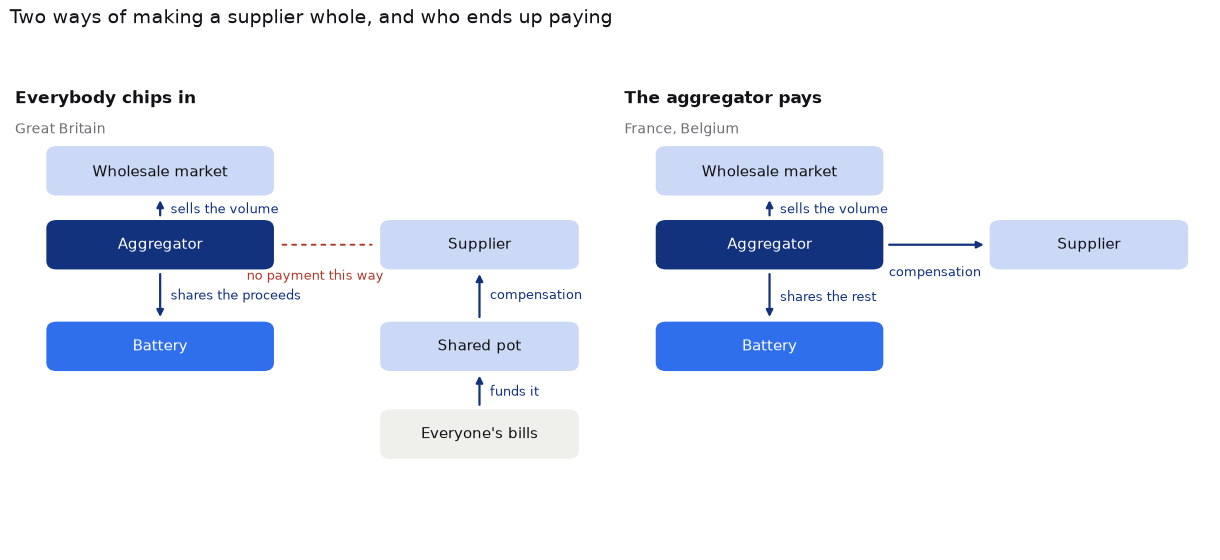
Since November 2024 an independent aggregator can register with the electricity settlement system in its own right and trade flexibility without the site's supplier taking any part in the trade.1
However, this creates an upstream issue as the supplier buys electricity in advance expecting the consumer to use it and if an aggregator turns demand down, the supplier is then holding energy it has paid for and cannot sell. It is therefore necessary for the supplier to be compensated, and in Great Britain that compensation is spread across every supplier in the market, which ultimately means consumers.2
That is a fair arrangement when the site really did use less. The difficulty is that the payment is calculated against a baseline, which is an estimate of what the site would have done anyway. Nobody can observe what would have happened. It has to be predicted, and this leaves the scheme open to abuse. Ofgem said as much before the rule went live, warning in its own analysis of the potential for an aggregator to “beat the baseline” without deploying any flexibility at all.3
How the scheme was exploited
Between September 2025 and February 2026 about 19 million pounds went through the compensation pot, and most of the growth came from large generators rather than from the consumer-led flexibility the route was built for.4
To put that in perspective, The Demand Flexibility Service, the national scheme that pays households and businesses to shift their demand, provided £1.2 million of rewards to consumers across the whole of winter 2024/25, with almost two million meters signed up. The compensation pot paid out roughly sixteen times that figure in six months, purely for squaring the books after a trade.
Consequently, as of 24 August 2026, a site whose largest half-hourly export over the past year was above 10 MW is now shut out of the route. If the largest export is under 2 MW, it remains in the scheme, and for those that sit between the two thresholds, if the site imported more than it exported over the past month, it can remain in the scheme. As such, for commercial and industrial battery storage, where exports are much lower than these thresholds, nothing has changed.
Route two: France, where the aggregator pays the supplier
Since 2014, in France an approved operator can sell a site's flexibility into the wholesale market, and RTE is explicit that the supplier's agreement is not required.5 However, as opposed to moving the cost to consumers, France publishes the price payable by an aggregator to a supplier. In 2025 an aggregator moving a remotely-metered site paid its supplier 62.00 euros per MWh in winter off-peak hours and 98.91 euros in winter peak hours, falling to 50.40 and 51.60 euros over the summer.6 Everyone can price the deal in advance, and there is much less room for manipulation, but equally trades are more expensive and consequently there are fewer of them.
Why it matters who pays the supplier back
You would expect an aggregator to prefer the version where it pays nothing. However, in March 2026 Flexitricity, an aggregator, formally asked to be made to pay.7 The reason for this is chiefly that a shared pot rewards flexibility in one direction only. An aggregator that turns a site's demand down sells the electricity that was not used and keeps the proceeds, while the shared pot pays the supplier back. An aggregator that charges a battery during periods of oversupply, when wholesale prices are low, receives nothing, because the supplier then takes the full benefit by billing the site at the retail price. Flexitricity's proposal would make the compensation run both ways, so that whoever gains from an action is the one who pays for it.
Furthermore, the pot ballooned to 19 million pounds in six months and the response from Ofgem was to exclude an entire class of asset from the scheme. An aggregator whose business depends on this scheme would rather pay a fair price and ensure that it remains open.
No clear route: Germany, the Netherlands, Spain, Portugal, Italy and Switzerland
Germany recognises independent aggregators, and they can prequalify for the balancing markets. For the wholesale market an aggregator needs a compensation agreement in place with the site's supplier, which brings the supplier's consent back in through the side door. One per cent of German customers are on a dynamic tariff and four per cent have a smart meter, against a target of twenty per cent by 2025 that was missed.8
The Netherlands recognises independent aggregators but gives them no wholesale access. The revised Energy Act, in force since January 2026, obliges suppliers to offer dynamic tariffs, which strengthens the supply-contract route. Four per cent of households and nine per cent of business customers are on dynamic contracts, on 89 per cent smart meter coverage.
Spain does not recognise independent aggregation at all. The framework that would have introduced it was written after the Iberian blackout of April 2025, and Spain's Congress rejected it in July, repealing the decree after 28 days.9 The replacement passed in November left the provision out. Spanish sites do have the retail route: smart metering is complete, 40 per cent of households are on the regulated hourly tariff and 19 per cent of business customers are on dynamic contracts, which is the highest of the ten markets here.
Portugal is earlier still, with a national flexibility assessment due in 2026 and demand-side response described by the International Energy Agency as at an early stage of development.
Italy allows aggregation in its balancing markets under the UVA framework but not in the wholesale market, and new aggregators could not even join the balancing markets between the end of 2024 and February 2026. Italian smart metering is near universal at 98 per cent, and dynamic tariff take-up is zero among households and three per cent among business customers.
Switzerland sits outside all of this. It is not in the European Union, so none of the rules above apply to it, its retail market is open only to sites using more than 100 MWh a year, and an aggregator working for retail customers is confined to the balancing market.
Belgium and Ireland, where it is still being designed
Belgium's Transfer of Energy framework has the same design as France, allowing an independent aggregator reach the wholesale market, with regulated compensation to the supplier. However, no activation has ever been recorded in those markets.8 The principal reason for this is that the framework reaches only medium and high voltage customers, so the addressable market is relatively narrow. From 2026 the framework extends to smaller assets, which may encourage a greater level of adoption.
In Ireland, a route for participation exists, but it is designed for large blocks of demand rather than individual buildings. An aggregator has to assemble at least 4 MW before it can bid anything in, so no single site qualifies on its own. Furthermore, the payment side was never settled: the scheme pays for energy only in the relatively rare hours when prices climb above a set threshold which has not proven to be sufficiently enticing for most aggregators. Irish regulators proposed a fix in March 2026 and closed the consultation on it in July, without reaching a decision.
How much price movement there is to work with
The value of any of this depends on how far prices move within a day, which varies more across Europe than the regulatory picture does. We measured the 2025 day-ahead year in all ten markets: the widest daily spreads sit in the Netherlands and Germany, and Great Britain, which has the most developed access rules of the ten, has one of the narrowest. The figures, and what they mean for how a battery should be sized in each market, are set out separately in what a battery has to work with: day-ahead price spreads in ten European markets.
What this means for a site owner
The UK and France stand out as the only markets in Europe with an established approach to letting a party other than the supplier trade a site's flexibility. In every other country in Europe, that route is either unbuilt or unused.
Outside those two markets, a behind-the-meter battery still makes sense when it is paired with a time-of-use tariff, even one that does not fully reflect the wholesale price. A tariff with three to five bands can still often earn a good return, especially when stacked with other sources of revenue.
However, batteries really come into their own where there are import capacity restrictions, or plans to increase a site's load substantially. In those cases the battery is not chasing a price at all. It is buying headroom on a connection, and the value of that does not depend on any of the market rules described above. We have worked that case through on a real meter in how battery storage can facilitate heating electrification and commercial fleet charging.
Common questions
What is P415?
P415 is the rule change that lets an independent aggregator sell a customer's flexibility into the wholesale electricity market in Great Britain. It took effect on 7 November 2024. The aggregator joins the settlement code in its own right, and the volume it moves is settled separately from the site's supply.
Does the electricity supplier have to agree?
No, and that is the whole point of it. The supplier takes no part in the trade and is compensated separately. European law has said the same thing since 2019, though most member states have not built the machinery to make it usable.10
Is there a size limit?
There is a ceiling rather than a floor. Since 24 August 2026 a site exporting more than 10 MW is excluded, one below 2 MW is eligible, and there is a test in between. A typical commercial site is far below the lower limit.
Is there a P415 equivalent in France?
Yes, and it is older. NEBEF has let an operator sell a French site's flexibility since 2014 without the supplier's agreement, NEBCO extends it to using more electricity as well as less, the minimum is 100 kW, and the aggregator pays the supplier at a published rate.
What about Germany, the Netherlands, Spain, Portugal, Italy, Belgium, Ireland or Switzerland?
Belgium has the framework and no recorded use of it. Ireland has a partial one that has been under design since 2019. Germany requires the aggregator to agree terms with the supplier. The Netherlands, Spain, Portugal and Italy have no wholesale route for independent aggregators. Switzerland is outside the European rules altogether.
Can a behind-the-meter battery sell into the wholesale market?
In Great Britain and France, through an aggregator. Everywhere else the practical route is a supply contract that passes wholesale prices through, which is available in all ten markets.
Try Lupa free for sixty days and price a battery against your own market and tariff
Notes
- Balancing and Settlement Code modification P415, “Facilitating access to wholesale markets for flexibility dispatched by Virtual Lead Parties”. Ofgem directed the change on 6 October 2023 with an implementation date of 7 November 2024. The aggregator's role in the code is a Virtual Trading Party, and the volume it moves is settled as a Deviation Volume. ↩
- Ofgem, decision on BSC modification P415, 6 October 2023. Compensation is paid to the affected supplier at a price representing average supplier sourcing costs, calculated using Ofgem's published Price Cap Methodology, and mutualised across suppliers. Ofgem assessed an alternative in which the aggregator paid, and the cost benefit analysis found the mutualised version supported greater volumes of flexibility. ↩
- Ofgem, decision on BSC modification P415, 6 October 2023, in its section on baselining. The cost benefit analysis warned of “the potential for VLPs to ‘beat the baseline’ without deploying flexibility”, where an aggregator able to forecast a site better than the baselining method “could then declare a flexibility action and deviation volume, while the consumer follows their existing demand profile”. Ofgem accepted the risk and said it expected industry to keep the method under review. ↩
- BSC modification P511, “Eligibility Boundaries for Generation Participation in P415”, raised by Axle Energy on 18 March 2026, in effect 24 August 2026. The test uses the largest half-hourly active export recorded for a metering system identifier pair over the previous 365 days, with an additional comparison of total export against total import over the previous 30 days for sites between the two thresholds. The 19 million pound figure covers 1 September 2025 to 28 February 2026 and comes from Elexon settlement data. ↩
- NEBEF, Notification d'Echange de Blocs d'Effacement, running since 2014 and being replaced by NEBCO, which extends it to consumption increases. RTE states that participation does not require the supplier's agreement, and that any mainland French consumption site may take part either as a demand response aggregator in its own right, subject to a 100 kW minimum, or through a third party. ↩
- RTE, “Historique des baremes de versement pour les Sites de Soutirage Telereleves”. The payment is made under Articles L.271-3 and R.271-8 of the French Energy Code. Figures are the 2025 scale, excluding VAT, for remotely-metered sites. ↩
- BSC modification P510, “Introducing Direct Compensation for Virtual Trading Party actions in the Wholesale Market”, raised by Flexitricity on 5 March 2026. Ofgem refused urgency on 31 March 2026 and the working group first met on 19 May 2026. The proposer's case is that mutualised compensation leaves aggregators with no incentive to provide bidirectional flexibility, and that direct compensation would align the wholesale market with the balancing mechanism, which moved to direct compensation under P444. ↩
- LCP Delta and smartEn, 2025 Market Monitor for Demand Side Flexibility, published January 2026, which assesses twelve European countries. It is the source for the aggregator position, dynamic tariff take-up and smart meter coverage in Belgium, Germany, Italy, the Netherlands and Spain, and for the absence of any recorded Transfer of Energy activation in the Belgian wholesale market. ↩
- Royal Decree-Law 7/2025 of 24 June 2025 was rejected by the Congress of Deputies on 22 July 2025 and repealed after 28 days in force. ↩
- Directive (EU) 2019/944, Article 13(2): a customer wishing to conclude an aggregation contract is entitled to do so “without the consent of the final customer's electricity undertakings”. Article 17(4) lets a member state require compensation to affected parties, with the method approved by the regulator. Member states were required to transpose it by 31 December 2020. ↩